
Leadership is not about pointing out who’s wrong. It’s about making sure we all move right.
Recently, my company has been undergoing a massive transformation. Teams that used to operate independently across different regions are now being brought together into unified global structures. One of the major changes was the creation of new Global practice hubs, which are centralized groups of experts meant to elevate standards and drive excellence across domains like architecture and engineering.
This kind of transformation brings opportunity, but it also introduces friction.
People are trying to adjust. Roles are shifting and understandably, tensions emerge, especially when long-standing ways of working are questioned or replaced. In this environment, I’ve noticed something subtle but dangerous creeping in public criticism of peers.
Architects hub
My company decided to introduce a new hub, a one for architects. This directly affected my teams, as I have a couple of them in my teams. These are people I care deeply about, both professionally and personally. I wanted this transition to be done right.
The responsibility for designing and launching this hub was taken on by a peer of mine. He’d been working on it for months, and recently, he organized a company-wide session to present the final shape of the plan.
What happened next caught me off guard and became the heart of this reflection.
The meeting that taught me a hard lesson
During the presentation, I felt a storm of emotions. As I listened, I became frustrated. My peer began with no clear vision, no plan, and no timeline. I imagined how my teams, smart, thoughtful people were hearing this and realizing just how little substance was behind such a major shift that directly impacted them.
My peer said that the plan had been discussed with the leadership team, so including me and had received full support. He even implied that the design had been co-created by our group.
But I knew that wasn’t true. I felt that I lost trust of my team. This is something I couldn’t bare.
I couldn’t stay silent. So, in the middle of the call, I spoke up. I asked direct questions about the missing details. I challenged the implied alignment. My goal wasn’t to attack, it was to protect. To show the architects that at least someone was willing to speak the truth.
What I didn’t expect was the backlash.
Not just from my peer, but from my whole leadership team.
That moment, that choice to call things out publicly, ended up teaching me more than I expected.

What I’ve learned after the fact
In Knights to King, one of the core leadership lessons is that
A good move doesn’t always make you a better player - you might win the moment but lose the board.
My intention was noble. My instincts were protective. But my execution? Flawed.
By publicly criticizing my peer, I didn’t just undermine his credibility. I also disrupted trust within the leadership group, and with the teams watching. What I thought was courage looked, to others, like division.
The more importantly, it positioned me against something not for something better.
Leading with care
After the situation, the moment I publicly challenged a peer in a company-wide meeting, I started asking myself a difficult but necessary question:
- What was my real motivation?
- Did I want to fix the situation?
- Or did I just want to prove a point?
The truth hurt, but it was clear: what I did might have been honest, but it wasn’t helpful and it certainly wasn’t Radical Candor.
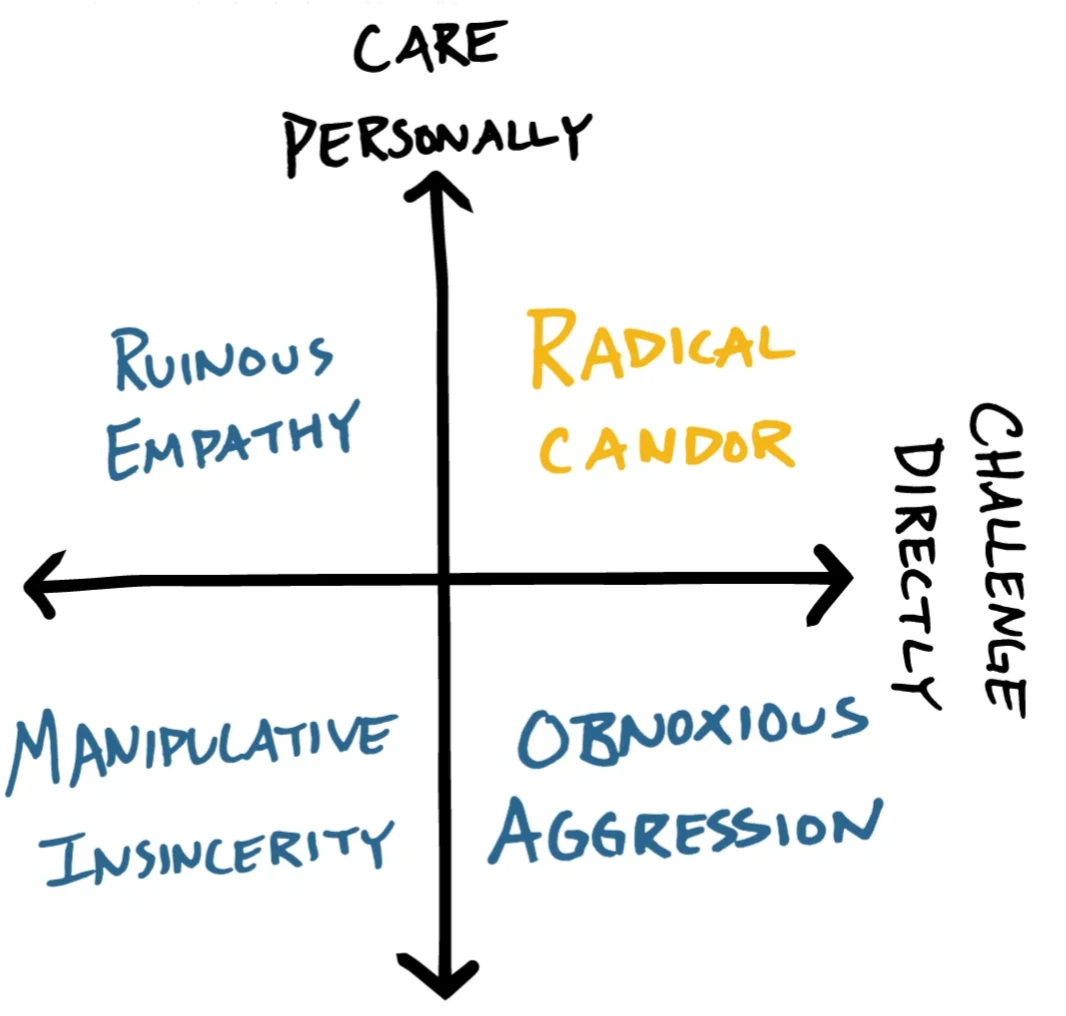
Radical Candor vs. Obnoxious Aggression
If you’re familiar with Kim Scott’s Radical Candor framework, you’ll know the two key axes it’s built on:
- Care personally
- Challenge directly
What I did by challenging my peer publicly, out of frustration, with no support or partnership landed squarely in the Obnoxious Aggression quadrant. I challenged directly, but I forgot the most important part to Care. That’s the moment when the real shift began.
Treating peers as people
I realized that if I truly wanted things to improve not just for my team, but for the whole organization I needed to treat my peers differently.
Not as colleagues I merely had to tolerate. Not as competitors I had to outperform, but as members of the same team. People I could support, coach, and even protect.

So I changed my approach.
I started setting up feedback sessions with my peers not as formal performance check-ins, but as open, human conversations. I began offering feedback using the SBI model (Situation–Behavior–Impact), making sure it always came from a place of care, not correction.
In yesterday’s meeting (S), I noticed you were unsure how to explain the timeline (B). I think that made the architects feel like this wasn’t fully thought through (I). Want to talk it through together before the next session? I would to help you preper better message in the future.
That’s what Radical Candor sounds like.

Becoming a peer leader
Over the time, something in my mind shifted. My conversations with my peers became deeper. Tensions gave way to trust. Even peers I didn’t naturally connect with started to open up.
Gradually, I noticed something else they started seeing me as a kind of leader not because of a title, but because of how I showed up.
I wasn’t just another voice in the room. I was a connector, a guide, a steady presence in a time of change.
We still had official manager, but within our cross-functional teams, the dynamic had shifted. We stopped competing. We started collaborating.

What I’ve learned
If you want to lead especially among your peers here’s what works:
- Replace judgment with curiosity,
- Give feedback privately, not publicly,
- Support others even when it doesn’t benefit you directly,
- Choose care over cleverness.
In the long run, leadership isn’t about how sharp your critique is, it’s about how much people trust that you’re in it with them.
Final thoughts
Remember, never (or at the very least), never criticize your peers, your teammates, your collaborators, or your leaders in public spaces.
Approach them with care and use the principles of Radical Candor.
If you see areas where they could do better, bring it up in a way that protects your relationship, not damages it. Do it on a one on one call and do it constructively. Do it with the intention to help, instead of to win.
Because when trust grows, performance follows.
And over time, you might be surprised by the results and so will they.