
Most leadership advice tells you to focus on strategy, communication and results. However, after years of leading through chaos, I’ve learned that none of that matters without trust.
Change and difficult challenges are part of every leader’s daily life. What I’ve noticed, though, is that many leaders approach these moments with hesitation, sometimes even resistance. For them, such situations feel stressful, uncertain, or overwhelming.
For me, it’s different. For years I wondered why. Why do I feel comfortable in situations that make others anxious?
Eventually, I came up with the conclusion. If I had to summarize it in one reason, it would be:
No matter what happens, I know I can rely on my team
I work with different managers across the company and I see this pattern repeating. Whenever there’s an unexpected project, an organizational change, or a sudden shift in priorities, many people react with fear or frustration. They’d rather the problem simply disappeared. Meanwhile, I find myself thinking: great, another challenge, let’s bring it to the team and figure it out together.
Not because I have all the answers and not because everything always goes smoothly. But because I have:
Trust and strong deep relationships with my team
If I could give my younger self one piece of advice about why things feel simpler now than they used to, the answer would be short Invest in deep relations built on trust with your team.
In this article, I’ll share a few practical ideas on what trust really means and how to strengthen it within any team. If you apply them consistently, you’ll notice how your collaboration improves and how you, as a leader, begin to achieve greater success with far more ease.

Why Trust Is the Foundation of Every Great Team
As leaders, we all want results. We expect our teams to deliver projects on time, achieve great outcomes and perform at their best, that’s natural. We’re responsible for performance, for metrics, for success.
But have you ever stopped to ask yourself:
- Does your team feel the same way you do about those goals?
- Do they feel the same sense of ownership, clarity and confidence?
Patrick Lencioni did and in his classic book The Five Dysfunctions of a Team, he described one simple truth that completely reshaped how I think about leadership:
Results are built on trust
Lencioni presents this simple chain of thoughts:
Without trust, there’s no open dialogue.
Without open dialogue, there’s no constructive conflict.
Without constructive conflict, there’s no commitment.
And without commitment, there’s no accountability for results.
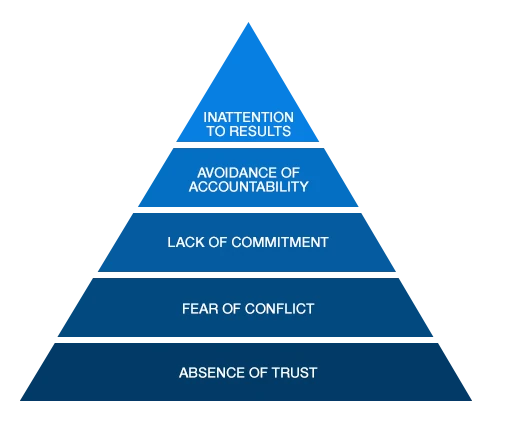
It’s a clear chain and yet, many leaders focus only on the top of it accountability and results.
We push for deadlines, we track progress, we measure performance, but when something breaks, we try to fix the symptoms instead of the foundation. That’s the paradox, because trust feels “soft,” when it’s actually the most measurable performance factor of all.
When people trust each other, they speak honestly, they challenge ideas, they take ownership and they deliver together.
So the next time you invest time in building relationships having open conversations, giving feedback, or simply checking in with your team remember that it is not lost time. It’s time invested in the very thing that drives results.

The Trust Equation
If you wonder how to build trust, it’s hard to believe but actually there’s a simple formula that explains how to do it in a surprisingly practical way. You can use it to increase trust with your team, peers, or colleagues:
Trust = (Credibility + Reliability + Intimacy) / Self-Orientation
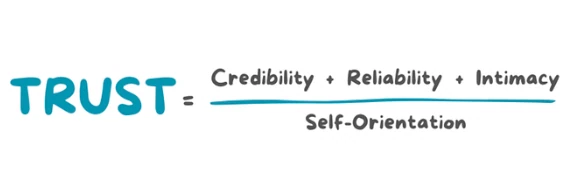
It says everything.
- Credibility — your expertise and understanding of the work. When your team sees that you truly understand what they do, you earn credibility. Nothing destroys trust faster than a manager who pretends to know everything about a topic they barely understand.
- Reliability — you do what you say. When you promise something, you deliver. When you say you’ll check on something, you actually follow up. People quickly notice whether your actions align with your words.
- Intimacy — treating people as people. Knowing a bit about their lives, remembering what matters to them, showing empathy when they’re going through something tough. It’s how professional relationships turn into genuine human connections.
Then there’s the denominator the hardest part:
- Self-Orientation. The more self-oriented you are, the less people will trust you. If they feel that every interaction with you is just about your own goals, trust collapses. You have to show that you care about them just as much, or even more, than yourself.
I once had a colleague who was always cheerful, friendly and competent. Yet, for very long time I couldn’t figure it out why I don’t trust him. It took me years to understand why and the answer was that he was deeply self-oriented. Everything he did somehow pointed back to his own success and this equation helped me finally see it clearly.

Radical Candor — Leading with Care and Challenge
One of the ideas that completely changed the way I think about leadership is Radical Candor. It’s simple in theory but incredibly powerful in practice.
At its core, Radical Candor means caring personally while challenging directly. It’s about leading people on two levels at once caring about their results and caring about them as human beings.
Many leaders focus on the first part results, KPIs, success metrics, but in doing so, they sometimes forget the second, that they’re working with people, not just performance charts. Unfortunately when that happens, trust erodes quietly.
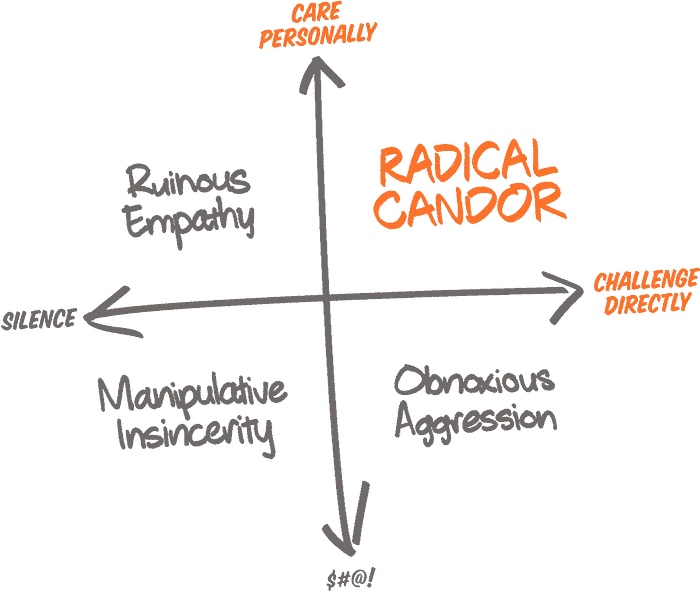
Caring personally doesn’t mean being soft. It means showing empathy, remembering what matters to your team and standing by them in difficult moments. Challenging directly, on the other hand, means being honest, having the courage to speak up, to hold people accountable and to help them grow, even when it’s uncomfortable.
Balancing those two is the art of leadership.
Too much challenge without care creates fear. Too much care without challenge creates comfort and stagnation. However, when both coexist, something special happens: people feel safe and motivated. They know you believe in them enough to tell them the truth.

Over the years, I’ve found myself returning to Kim Scott’s Radical Candor again and again, roughly every two years. Each time, I rediscover the same truth:
When you lead with care, everything else becomes lighter, simpler and more natural
Collaboration improves. Feedback flows more easily and people start treating you with the same honesty and respect you show them. That’s how healthy cultures are built one caring, honest conversation at a time.
Relationships Are an Investment for Harder Times
Another aspect that makes a real difference and something I consistently see among leaders who achieve better results is understanding that:
Relationships aren’t built during a crisis, they’re built for a crisis
They’re an investment you make today so that tomorrow’s challenges become easier.
When a difficult project suddenly lands on your plate, or something needs to be delivered “by the end of the week,” having strong relationships completely changes the conversation. Your team says things like:
“Hey, we’ll help. We understand the situation. Let’s figure this out together.”
Trust gives you that peace of your mind. Good relationships show people that you genuinely care and because of that, they want to help you, not because they have to or you are their boss.

Building Trust When There’s “Nothing Urgent”
Too many leaders treat their work as a list of tasks. When there’s no immediate issue, they cancel one-on-ones or stop investing time in their people. That’s a mistake.
The quiet periods, when everything seems calm, are exactly when you should be building trust. That’s the time to talk with your team, help them grow, understand their motivations and support their career goals.
Knowing that when the next storm comes and trust me it always does, you’ll have a team that stands behind you. When you have that, every challenge suddenly feels much much simpler.

Summary
Building trust with your team is one of the best investments you can make as a leader. It doesn’t just help you in the good times, it gives you peace of mind when things get hard. When trust is strong, you no longer face challenges alone. You have people who stand with you, ready to move forward together.
So take the time to build real relationships. Be reliable, stay close to your people, and care not only about the work, but about them. Try applying these ideas in your daily leadership practice, and you’ll quickly notice how the quality of collaboration and team energy improves dramatically.