
Leadership rarely feels like standing on solid ground. It feels like swimming. Not the calm, postcard kind, but the slow crawl where your head stays just above the surface. You aim for the shore, spot a buoy, think you will rest for a moment and that is exactly when someone throws another responsibility at you. A meeting. A decision. A quick question that quietly eats half your afternoon. You do not drown, but you are never dry either.
This is how many leaders operate day after day. In a constant state of mild overload. Functional but tense. Moving but rarely resting.
There is a strange joke hidden in modern work culture. We are obsessed with the word sprint. Agile sprint. Planning sprint. Delivery sprint. It sounds energetic and noble. The problem is simple. Leadership is not a sprint.
Leadership is closer to a long distance run with no finish line and a route that keeps changing while you are already tired. Still, we behave as if speed alone will save us. Faster responses. Faster decisions. Faster context switching. Motion replaces direction and exhaustion starts to feel normal.

Why Simple Tools Matter
After a while, clever frameworks stop helping. Not because they are wrong, but because they collapse when you are tired. Simple ideas survive bad days. They fit in your head when everything else feels noisy.
This is why I keep returning to the Eisenhower Matrix. Not because it feels clever, but because it refuses to pretend that everything matters equally.
Imagine a blank square divided into four smaller ones. Two simple questions run through it. Is this urgent. Is this important. Nothing more. Every task you carry around in your head has to answer those two questions, even if the answer makes you uneasy.
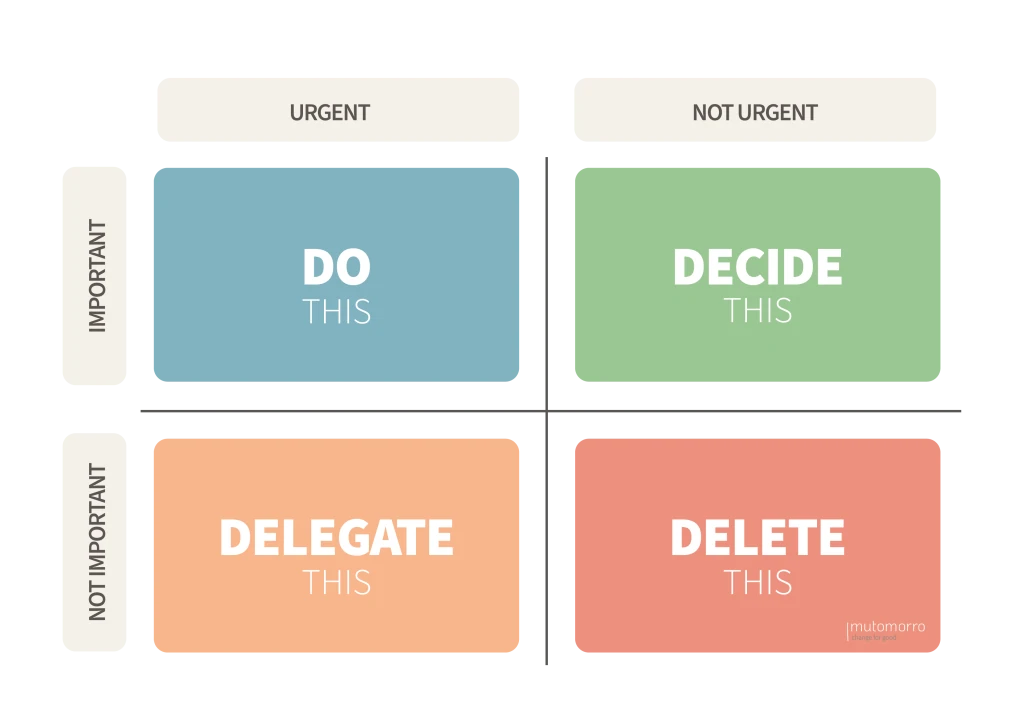
Some tasks land in the top left corner. Urgent and important. Fires. Deadlines. Things that will hurt if ignored. These are the only tasks that deserve your full attention right now. While they are unfinished, everything else becomes background noise.
Some tasks look urgent but are not important. Messages that demand an instant reply. Meetings that feel loud but change nothing. These tasks shout, but they rarely move anything forward. Seeing them grouped together makes their nature obvious in a way a long list never does.
Then there is the quiet but dangerous corner. Not urgent, yet important. Thinking. Planning. Work that shapes the future but never screams for attention. This box explains why leaders feel busy and still feel behind. These tasks slip easily unless you protect space for them.
The last box is the hardest to face. Not urgent and not important. Tasks that survive out of habit, fear, or politeness. They look innocent on a to do list. Inside the matrix, they lose their disguise. Their only real destination is removal.
The matrix works because it forces a decision, not a plan. You cannot hide behind good intentions. Every task must stand somewhere. Once it does, the next move becomes obvious.
The Box Everyone Avoids
Most people look at the urgent and important box first. It brings relief. It tells you what deserves attention right now and gives you permission to ignore the rest for a moment.
The real value sits somewhere else.
Not urgent. Not important.
This box is uncomfortable. It exposes how much of your task list exists out of habit, guilt, or vague anxiety. Without a filter, this list grows forever. With the matrix, something unexpected happens. Tasks vanish. Instantly. No execution required. No productivity tricks. Just a decision to let them go.
The Permission to Delete Work
For many leaders, this is emotionally difficult. To do lists feel like proof of effort. Crossing items off creates a sense of progress and control. Removing items completely can feel like cheating or worse like failure.
The Eisenhower Matrix quietly changes that relationship. It gives you permission to delete work. Not postpone it. Not hide it. Delete it. To accept that some things should never be done at all.
This alone can shrink the mental weight you carry every day.

A Shift in Thinking
The matrix works best when it stops being a tool you open once a week. It becomes a reflex.
You are in a meeting. The discussion is interesting. Ideas start flowing. You feel the pull to get involved. Pause. Is this urgent. Is this important. Often, once the emotional heat fades, the answer is no. The decision becomes easy and almost dull.
That dullness is freedom.
Choosing What Not to Touch
This is not really about time management. It is about restraint. Leadership is not measured by how many things you touch, but by how many you consciously decide not to.
When you stop treating every task as a moral obligation, something shifts. The water feels a little shallower. You are still swimming, but with direction. From time to time, you actually reach the shore.

Summary
Leadership overload rarely comes from too little discipline. It comes from saying yes to too much. The Eisenhower Matrix works because it forces honest choices, not better intentions. It shows which tasks deserve focus, which can wait and which should disappear entirely. By treating simplicity as a daily habit rather than a planning exercise, leaders regain clarity, reduce noise and make room for work that truly matters.